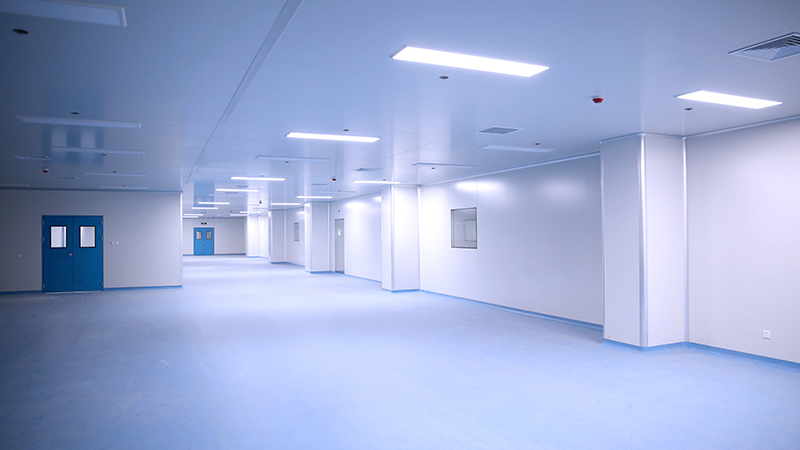
Room with a defined concentration of airborne particles, designed and used in a way that the number of particles introduced into the room or originating and being deposited in the room is as small as possible, and in which other cleanliness-relevant parameters such as temperature, humidity and pressure can be controlled as required. (VDI 2083-1)
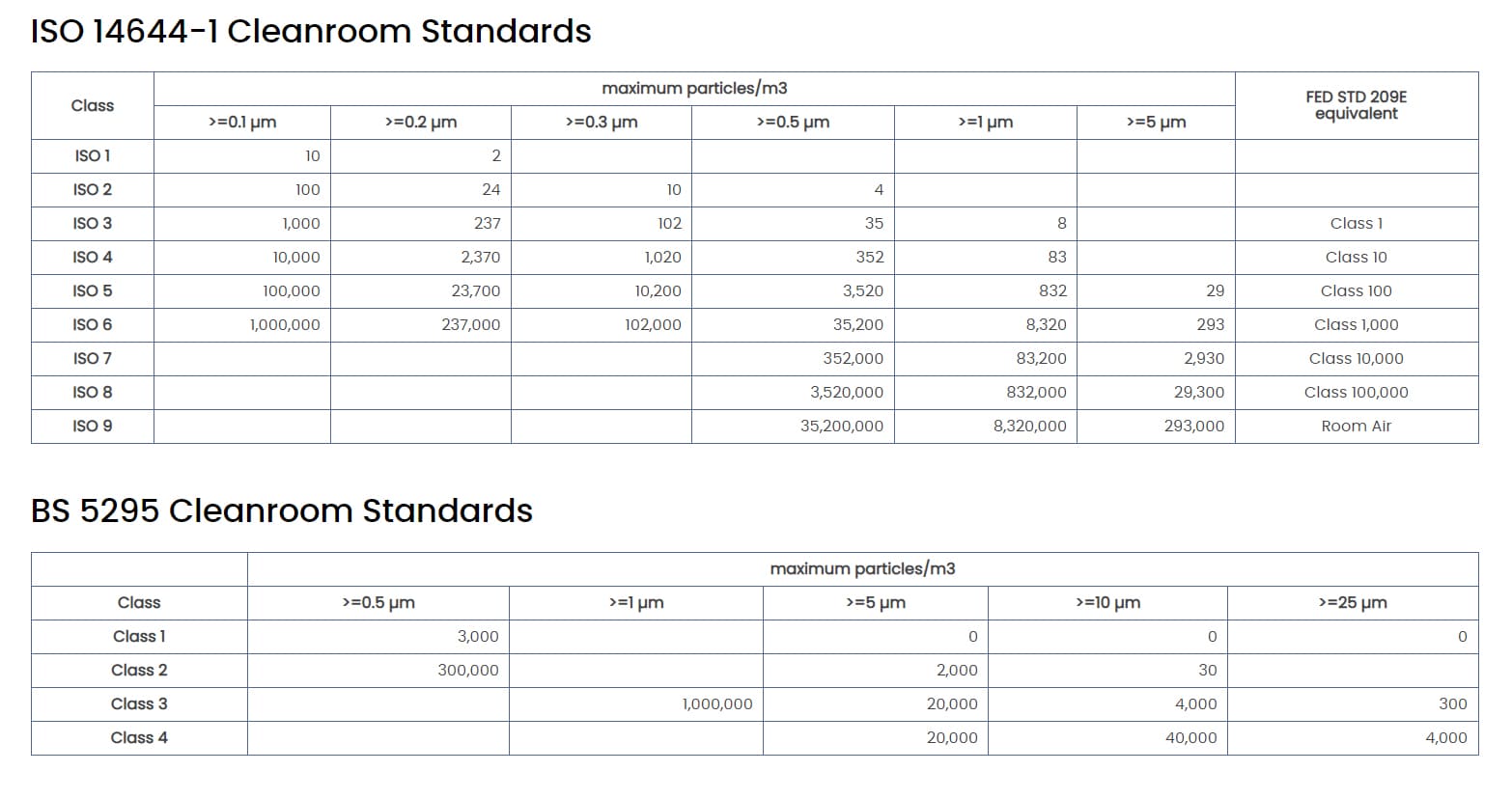
Typically used in manufacturing or scientific research, a cleanroom is a controlled environment that has a low level of pollutants such as dust, airborne microbes, aerosol particles, and chemical vapors. To be exact, a cleanroom has a controlled level of contamination that is specified by the number of particles per cubic meter at a specified particle size. The ambient air outside in a typical city environment contains 35,000,000 particles per cubic meter, 0.5 micron and larger in diameter, corresponding to an ISO 9 cleanroom which is at the lowest level of cleanroom standards.
1. Turbulent dilution flow: “non-unidirectional airflow. Air distribution during which primary air entering the cleanroom or clean area is mixed with the room air by means of induction.” (ISO 14644-1 - 2016-06) The filtered clean air is introduced into the clean room with a swirling effect and generates an increasing dilution of the particle concentration. With this flow principle, the staff’s behaviour according to clean room conditions is particularly important in order to ensure the required airborne particulate cleanliness class.
2. Low-turbulence displacement flow: “unidirectional airflow, regulated airflow with uniform speed across the entire cross-section of a cleanroom or clean area, which is regarded as parallel airflow.” (DIN EN ISO 14644-1 - 2016-06) This is also called “laminar flow” and requires a low-turbulence inflow. In this procedure, the air escapes on the opposite side, normally consisting of a perforated double floor. From there, it returns into the recirculation device where it is filtered again. The low-turbulence displacement flow is particularly suitable for sensitive work areas.
Cleanrooms are classified by how clean the air is. In Federal Standard 209 (A to D) of the USA, the number of particles equal to and greater than 0.5µm is measured in one cubic foot of air, and this count is used to classify the cleanroom. This metric nomenclature is also accepted in the most recent 209E version of the Standard. Federal Standard 209E is used domestically. The newer standard is TC 209 from the International Standards Organization. Both standards classify a cleanroom by the number of particles found in the laboratory's air. The cleanroom classification standards FS 209E and ISO 14644-1 require specific particle count measurements and calculations to classify the cleanliness level of a cleanroom or clean area. In the UK, British Standard 5295 is used to classify cleanrooms. This standard is about to be superseded by BS EN ISO 14644-1.
Cleanrooms are classified according to the number and size of particles permitted per volume of air. Large numbers like "class 100" or "class 1000" refer to FED_STD-209E, and denote the number of particles of size 0.5 µm or larger permitted per cubic foot of air. The standard also allows interpolation, so it is possible to describe e.g. "class 2000."
Small numbers refer to ISO 14644-1 standards, which specify the decimal logarithm of the number of particles 0.1 µm or larger permitted per cubic metre of air. So, for example, an ISO class 5 cleanroom has at most 105 = 100,000 particles per m³.
Both FS 209E and ISO 14644-1 assume log-log relationships between particle size and particle concentration. For that reason, there is no such thing as zero particle concentration. Ordinary room air is approximately class 1,000,000 or ISO 9.