
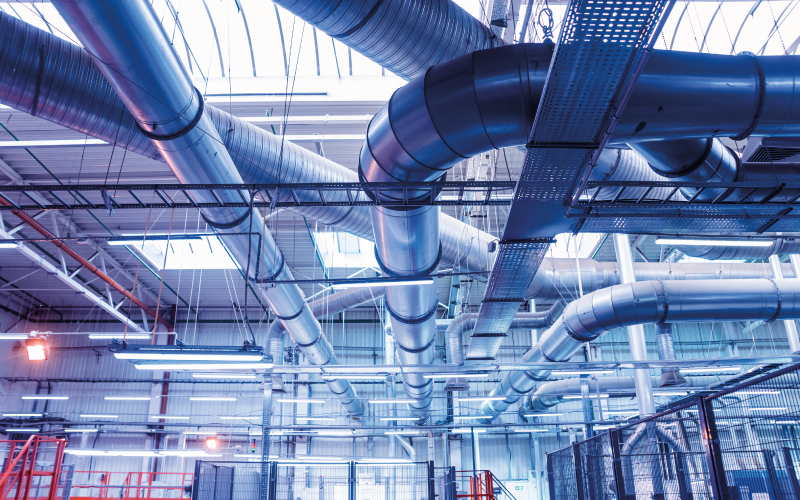
HVAC systems are milestones of building mechanical systems that provide thermal comfort for occupants accompanied with indoor air quality. HVAC systems can be classified into central and local systems according to multiple zones, location, and distribution. Primary HVAC equipment includes heating equipment, ventilation equipment, and cooling or air-conditioning equipment. Central HVAC systems locate away from buildings in a central equipment room and deliver the conditioned air by a delivery ductwork system. Central HVAC systems contain all-air, air-water, all-water systems. Two systems should be considered as central such as heating and cooling panels and water-source heat pumps. Local HVAC systems can be located inside a conditioned zone or adjacent to it and no requirement for ductwork. Local systems include local heating, local air-conditioning, local ventilation, and split systems.
The three main functions of an HVAC system are interrelated, especially when providing acceptable indoor air quality and thermal comfort. Your heating and air conditioning system is often one of the most complicated and extensive systems in your home, but when it stops working you’ll know soon enough! There are nine parts to your HVAC system that you should be familiar with the air return, filter, exhaust outlets, ducts, electrical elements, outdoor unit, compressor, coils and blower.
System selection depends on three main factors including the building configuration, the climate conditions, and the owner desire [2]. The design engineer is responsible for considering various systems and recommending more than one system to meet the goal and satisfy the owner of a building. Some criteria can be considered such as climate change (e.g., temperature, humidity, and space pressure), building capacity, spatial requirements, cost such as capital cost, operating cost, and maintenance cost, life cycle analysis, and reliability and flexibility.
However, the selection of a system has some constraints that must be determined. These constraints include the available capacity according to standards, building configuration, available space, construction budget, the available utility source, heating and cooling building loads.
| Criteria | Central system | Decentralized system |
|---|---|---|
| Temperature, humidity, and space pressure requirements | Fulfilling any or all of the design parameters | Fulfilling any or all of the design parameters |
| Capacity requirements |
Considering HVAC diversity factors to reduce the installed equipment capacity Significant first cost and operating cost |
Maximum capacity is required for each equipment Equipment sizing diversity is limited |
| Redundancy | Standby equipment is accommodated for troubleshooting and maintenance | No backup or standby equipment |
| Special requirements |
An equipment room is located outside the conditioned area, or adjacent to or remote from the building Installing secondary equipment for the air and water distribution which requires additional cost |
Possible of no equipment room is needed Equipment may be located on the roof and the ground adjacent to the building |
| First cost |
High capital cost Considering longer equipment services life to compensate the high capital cost |
Affordable capital cost |
| Operating cost |
More significant energy efficient primary equipment A proposed operating system which saves operating cost |
Less energy efficient primary equipment Various energy peaks due to occupants’ preference Higher operating cost |
| Maintenance cost | Accessible to the equipment room for maintenance and saving equipment in excellent condition, which saves maintenance cost | Accessible to equipment to be located in the basement or the living space. However, it is difficult for roof location due to bad weather |
| Reliability | Central system equipment can be an attractive benefit when considering its long service life | Reliable equipment, although the estimated equipment service life may be less |
| Flexibility | Selecting standby equipment to provide an alternative source of HVAC or backup | Placed in numerous locations to be more flexible |